Tampilkan postingan dengan label Peter F. Hamilton. Tampilkan semua postingan

Rabu, 14 September 2011

Short but Great Stories

I'm not your typical short-story lover. In general, I wouldn't really consider short story my favourite format however I've always believed that they fit some genres much better than others. The obvious one is horror. And I would add to that science-fiction.

Sometimes, depending on my mood, I find it very liberating not to commit to a whole book to fully enjoy a good story. I also happen to read a couple of books at the same time therefore short stories suit much better the genre switching that my mood might dictate. They also provide a great way to discover new authors and new styles.

Here are some of my recent books containing some great stories:

House of Fear
edited by Jonathan Oliver

Paperback: 408 pages
Publisher: Rebellion (14 Oct 2011)
ISBN-10: 1907992065
ISBN-13: 978-1907992063

The tread on the landing outside the door, when you know you are the only one in the house. The wind whistling through the eves, carrying the voices of the dead. The figure glimpsed briefly through the cracked window of a derelict house.

Editor Jonathan Oliver brings horror home with a collection of haunted house stories by some of the finest writers working in the horror genre, including Joe R. Lansdale, Sarah Pinborough, Lisa Tuttle, Christopher Priest, Adam L. G. Nevill, Nicholas Royle, Chaz Brenchley, Christopher Fowler, Gary Kilworth, Weston Ochse, Eric Brown, Tim Lebbon, Nina Allan, Stephen Volk, Paul Meloy and more.


Manhattan in Reverse
by Peter F. Hamilton

Hardcover: 320 pages
Publisher: Macmillan (7 Oct 2011)
ISBN-10: 0230750303
ISBN-13: 978-0230750302

A collection of short stories from the master of space opera. Peter F Hamilton takes us on a journey from a murder mystery in an alternative Oxford in the 1800s to a brand new story featuring Paula Mayo, Deputy Director of the Intersolar Commonwealth’s Serious Crimes Directorate. Dealing with intricate themes and topical subject this top ten bestselling author is at the top of his game.

Engineering Infinity
edited by Jonathan Strahan

Paperback: 416 pages
Publisher: Solaris (15 Jan 2011)
ISBN-10: 1907519513
ISBN-13: 978-1907519512

The universe shifts and changes: suddenly you understand, you get it, and are filled with a sense of wonder. That moment of understanding drives the greatest science-fiction stories and lies at the heart of Engineering Infinity. Whether it's coming up hard against the speed of light and, with it, the enormity of the universe, realising that terraforming a distant world is harder and more dangerous than you'd ever thought, or simply realising that a hitchhiker on a starship consumes fuel and oxygen with tragic results, it's hard science-fiction where sense of wonder is most often found and where science-fiction's true heart lies. This exciting and innovative anthology collects together stories by some of the biggest names in the field, including Stephen Baxter, Charles Stross and Greg Bear.

The End of The Line
edited by Jonathan Oliver

Paperback: 374 pages
Publisher: Solaris (1 Nov 2010)
ISBN-10: 1907519327
ISBN-13: 978-1907519321

New horror stories set on and around the Underground
In deep tunnels something stirs, borne on a warm breath of wind, reeking of diesel and blood. The spaces between stations hold secrets too terrible for the upper world to comprehend and the steel lines sing with the songs of the dead.

The End of The Line collects some of the very best in new horror writing in an themed anthology of stories set on, and around, the Underground, the Metro and other places deep below. This collection of 19 new stories includes thoughtful, disturbing and terrifying tales by Ramsey Campbell, Christopher Fowler, Mark Morris, Pat Cadigan, Adam Nevill and Michael Marshall Smith amongst many others.

Senin, 05 September 2011

REVIEW: The Reality Dysfunction by Peter F. Hamilton

The Reality Dysfunction by Peter F. Hamilton
Publishing information: Paperback; 1120 pages
Publisher: Orbit; 8 Oct 2008
ISBN 10: 0316021806
ISBN 13: 978-0316021807
Series: Book 1 of the Night's Dawn Trilogy
Copy: Out of pocket
Reviewer/: Tyson

Back of the book: "Space is not the only void...

In AD 2600 the human race is finally beginning to realize its full potential. Hundreds of colonized planets scattered across the galaxy host a multitude of prosperous and wildly diverse cultures. Genetic engineering has pushed evolution far beyond nature's boundaries, defeating disease and producing extraordinary spaceborn creatures. Huge fleets of sentient trader starships thrive on the wealth created by the industrialization of entire star systems. And throughout inhabited space the Confederation Navy keeps the peace. A true golden age is within our grasp.

But now something has gone catastrophically wrong. On a primitive colony planet a renegade criminal's chance encounter with an utterly alien entity unleashes the most primal of all our fears. An extinct race which inhabited the galaxy aeons ago called it "The Reality Dysfunction." It is the nightmare which has prowled beside us since the beginning of history.

THE REALITY DYSFUNCTION is a modern classic of science fiction, an extraordinary feat of storytelling on a truly epic scale."


I have been pondering just how I was going to write this review, the book is massive and is only the opening shot in the trilogy. A lot of characters are introduced and ideas brought into play. With that in mind I am not even sure that I can give this a fair review but I will do what I can.

The Reality Dysfunction takes place in several galaxies and planets. Nearly every niche in human society has their own personal planet. There is also two ways that humans have branched off, the Edenists and the Adamists. Edenists have used gene technology which has given them the ability to communicate telepathically (human and other creatures) and over generations of breeding several other abilities. The Edenists are more technological using Bitek or Biological technology to enhance their lively hood. The Adamists have a much better life overall but both do quite well in the future. Aside from the differences in human ideology, each planet is different from the others. There are a few planets that come to the forefront in this novel, one is the main planet, named Tranquility, for commerce as well as a center for one strand of humanity. There is also a planet, Lalonde, where things start to unravel and has a wild west, make it on your own and by the sweat of your brow feel to it. I found it funny, although I doubt Hamilton intended it to be that way, but Canada received its own planet. But with the two ideologies and the various planets representing nationalities and different ways of life, leads the book into many different planets and ecologies which is interesting. There are a few other species that are included in Hamilton's universe and they play a big role in the opening novel to the trilogy but, I have to keep some things close to my chest for fear of divulging too much plot. I will say that they are not what you expect and they are unique.

Since The Reality Dysfunction spans the universe and is a space opera in the grandest sense, there are a myriad of characters to keep track of. There is Joshua Calvert, who is your typical rogue. He loves women and they in turn love him. Syrinx a former Navy Captain turned privateer with a bone to pick with Calvert. She also has a Voidhawk, a living interstellar space ship that is bonded to her. Quinn Dexter, a former gang member on forced to work on Lalonde as punishment for his crimes on Earth. He is also a practicing satanist, which brings all kinds of chaos along with it. I could go on and on about the other characters in the book but the list if very long and each one has a very detailed history and motivations.

Aside from Hamilton's impressive planets and characters there is also a political angle in the novel which has several different factions and reasons for existence. There is a lot to take in in this first installment and in all honesty I was lost (and a tad bit bored) with the first 300 pages as there is some action;however, mainly it serves to set up the stage for the rest of the novel. The reason I was lost is there is very little information that you get to help you keep the people straight and their motivations and factions apart. I just ended up plugging away at it until I finally formed a clearer picture in my head and was able to see who was who.

The Reality Dysfunction is an ambitious space opera and I found it entertaining at times, at other times I was either playing catch up or bored to death waiting for the build up to finally come to its close or at least prepare me for what was the bigger picture. The Reality Dysfunction is also very large. As I have not finished the series (and seriously debating whether I want to simply because of their size) I am not sure if there could have been some major editing as a lot of the book feels slightly padded. Again, I have not read the sequels so, I don't know how or if some of it plays a part in the later acts. However, if you do love space operas, I would have to say this one needs to be on your list. It has some great characters, a enormous universe with some great technology, and the idea/plot was an unexpected delight.

Plot 9
Characters 9
Style 7

Overall 8/10

Senin, 06 Juni 2011

REVIEW: Fallen Dragon by Peter F. Hamilton


Fallen Dragon by Peter F. Hamilton
Publishing Information: Paperback; 832 pages
Publisher: Orbit; 14 Dec 2009
ISBN 10: 0-316-02183-0
ISBN 13: 978-0-316-02183-8
Standalone
Copy: Out of Pocket
Reviewer: Tyson

Back of the Book: "As a child, Lawrence Newton wanted nothing more than to fly starships and explore the galaxy, like his fictional heroes. But on the colony world of Amethi in the twenty-fourth century, Lawrence is living in the wrong era: the age of human starflight is drawing to a close. So, like many another teenage hothead, he rebels and runs away.
Twenty years later, he's the seargent of a washed-out platoon taking part in the bungled invasion of another world. The giant corporations who own the remaining starships euphemistically call such campaigns 'asset realization'. In practice it's simple piracy.

But while he's on the ground, being shot at and firebombed by disturbingly effective resistance forces, Lawrence hears stories about the Temple of the Fallen Dragon - the holy place of a sect devoted to the worship of a mythical creature that fell from the sky millenia before the arrival of humans. More importantly, its priests are said to guard a hoard of treasure large enough to buy lifelong happiness for any man, and that information alone is enough to prompt him to mount a small private-enterprise."


When you set your sights on reading a Peter F. Hamilton novel you have to ask yourself, "Where do I start?" Nearly every novel is a door stop and will require a little bit of time to complete. But nearly everyone I posed this question to said the same thing. If you want to try reading Hamilton then you can start nearly anywhere, but your best bet is Fallen Dragon as it is a standalone and does a fairly good job of representing Hamilton's talent as a writer.

Fallen Dragon is massive but not nearly as large as his 3,000+ page Night's Dawn Trilogy. Fallen Dragon follows a young visionary named Lawrence Newton. Lawrence dreams of traveling the distant stars and expanding mankind's knowledge of the universe. When things go bad at home he drops everything and sets off to make his dream a reality. While Lawrence makes his living as a mercenary, we are given his entire life's story through a series of flashbacks that tell us of how he ended up working as a hired gun for one of the universes largest companies. Most mercenaries are not considered very honorable and when you first meet Lawrence you get the feeling that he is your typical mercenary. But as time moves forward and you learn of his past he becomes very enduring. Along the way we meet a lot of Lawrence's squad mates and former loves. His father which plays a pivotal role in his choices and upbringing is not very well drawn out considering he is the catalyst for a lot of what happens in his early life.

The universe that Hamilton has created is interesting in that space travel is expensive and profit margins need to be maintained in order to continue exploring the vast reaches of space and all the planets. With Earth at its capacity and mankind wanting to live lives going many different paths, corporations have funded the colonization of habitable planets.The catch is that the colonists are indebted to the companies and from time to time they are required to send their riches to the corporations to lower their debts. As the colonists become less and less dependent on Earth they no longer feel the need to be beholden to their debts. This is were the mercenary comes in. They are required to land on the planet, secure the cities and then with an iron grip on the populace retrieve anything the corporation deems profitable. In effect, they are pirates. In a way it must have been the way Americans felt towards the end before they shouted for independence from the British.

With the corporations realizing that this method of colonization followed by plunder is no longer a viable option the time of exploration is coming to a close. Lawrence also realizes that his dream of visiting new worlds is coming to an end and has a plan of his own. In the opening sequence of the book we find him conspiring with another officer to enact his plan and have to wait until nearly the end of the book before it picks up again. As I read Fallen Dragon, I kept wondering when we would return to the plot the book starts out with and when we finally did it really did not have all the intrigue that was built up in the opening chapter. I was hoping for something bigger and more intense but it just never happened. Admittedly, the ending was very satisfying and interesting. Plus the treasure that is found on the planet was not what I was expecting. It was a nice change of pace.

Fallen Dragon is a great introduction to Peter F. Hamilton. It has just what I was looking for: adventure, action, a little romance, and some political sidestepping. While it is a very large book it reads well. Well developed characters and universe make for an adventure that is hard to put down. Highly recommended.

Plot 9
Characters 9
Style 9

Overall 9/10

Jumat, 04 Februari 2011

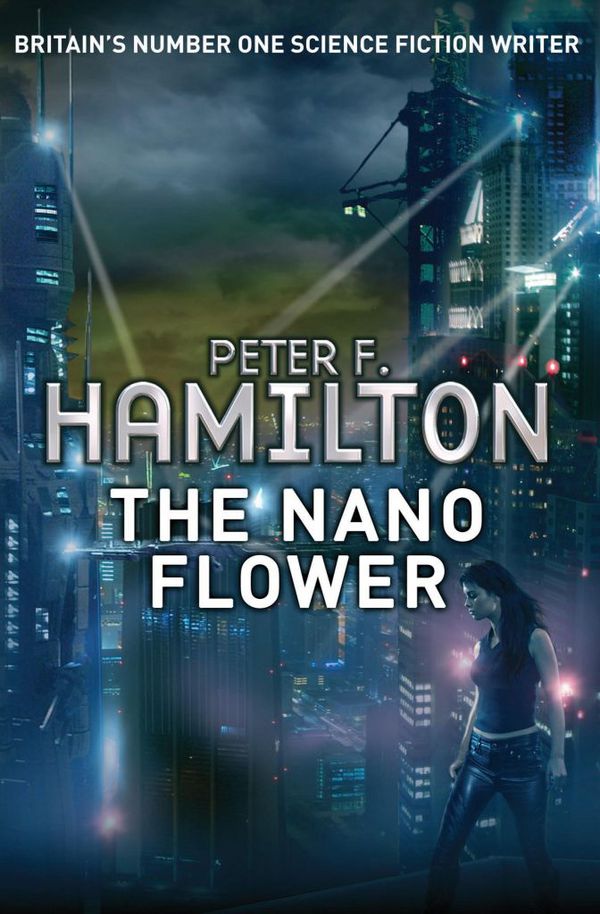
New Artwork of Peter F. Hamilton's Greg Mandel Trilogy

We now have the new artwork for Peter F. Hamilton's Greg Mandel trilogy. The trilogy will be republished in the UK in October 2011 by Tor.

The stories are set in a near-future England, centred around Hamilton's own home county of Rutland. Mandel is a former officer of the "English Army", who fought in the "Mindstar Brigade", a tactical psychic unit. He was given the psychic powers of intuition and detecting emotions, skills he uses for his new profession of psychic detective.

Mindstar Rising

It's the 21st century and global warming is here to stay, so forget the way your country used to look. And get used to the free market, too – the companies possess all the best hardware, and they're calling the shots now.

In a world like this, a man open to any offers can make out just fine. A man like Greg Mandel for instance, who's psi-boosted, wired into the latest sensory equipment, carrying state-of-the-art weaponry – and late of the English Army's Mindstar Battalion.

As the cartels battle for control of a revolutionary new power source, and corporate greed outstrips national security, tension is mounting to boiling point – and Greg Mandel is about to face the ultimate test.

A Quantum Murder

Dr Edward Kitchener, a brilliant researcher into quantum cosmology for the Event Horizon conglomerate . . . but no good to anybody now, lying dead with his lungs spread out on either side of his open chest.

The security system at Launde Abbey was premier-grade, yet a mercenary could still have got through, and plenty of people anxious to stop Kitchener’s work would pay the killer’s fee. But why would a professional waste time in ritually slaughtering the target?

Event Horizon needs to know fast, so Greg Mandel, psi-boosted ex-private eye, is enticed out of retirement to launch himself on a convoluted trail involving confrontation with a past which – according to Kitchener’s theories – might never have happened.

The Nano Flower

Julia Evans, billionairess owner of Event Horizon, has for fifteen years been the power behind England’s economic renaissance – but now she’s in trouble.

With her husband missing, and rival companies suddenly claiming to have acquired a technology impossibly superior to anything on Earth, she has no time to take notice of a single flower delivered anonymously. But this flower possesses genes millions of years in advance of any terrestrial DNA.

Is it a cryptic alien message, or a poignant farewell token from her husband? One man might discover its origin – but Greg Mandel will not be alone in his desperate search. And, as they both now discover, simply being first in the race isn’t nearly good enough when the Nano Flower begins to bloom ...

Senin, 13 Desember 2010

REVIEW: Pandora's Star by Peter F. Hamilton

Pandora's Star by Peter F. Hamilton
Publishing Information: Paperback; 1152 pages
Publisher: Pan; New edition edition (4 Mar 2005)
ISBN 10: 0330493310
ISBN 13: 978-0330493314
Series: 1st book of the Commonwealth Saga
Copies: Out of pocket
Reviewers: Yagiz

In AD 2329, humanity has colonised over four hundred planets, all of them interlinked by wormholes. With Earth at its centre, the Intersolar Commonwealth now occupies a sphere of space approximately four hundred light years across. When an astronomer on the outermost world of Gralmond, observes a star 2000 light years distant - and then a neighbouring one - vanish, it is time for the Commonwealth to discover what happened to them. For what if their disappearance indicates some kind of galactic conflict? Since a conventional wormhole cannot be used to reach these vanished stars, for the first time humans need to build a faster-than-light starship, the Second Chance. But it arrives to find each 'vanished' star encased in a giant force field -- and within one of them resides a massive alien civilisation.

The first two massive books of Peter F. Hamilton's The Void Trilogy had been on my desk when I received The Evolutionary Void, the final instalment of the trilogy. I was ready to sit and savour one of the greatest recent space operas however after consulting some avid sci-fi readers, I decided that it would be better to start the Commonwealth Saga before The Void Trilogy. Now that I read Pandora's Star I'm intending to read the remaining four books without leaving much gap between them.

Pandora's Star starts with one of the historical moments of mankind: landing on Mars sometime during the 21st century. However the discovery of the wormhole technology gives humanity a much bigger window of opportunities to spread throughout the near universe. After the first few pages, the story jumps in time and takes the reader to almost four centuries ahead. In this future, wormholes are the common way to accomplish inter-planetary travel and humanity has reached immortality by way of cloning, memory archiving and restoring, and rejuvenation. The main plot starts when an astronomer discovers the sudden disappearance of Dyson Alpha, a star that is light years away from the border of Commonwealth, which is composed of 600 inhabited planets. The author thickens the plot with mystery, murder investigations, politics and alien races.

It is not surprising that in this quite large book, that is also the beginning of a quite large series, the setting is immense. It is wide and deep. The reader is told about many inhabited planets that are part of the Commonwealth. When the author introduces a new planet to the story, he spends some time talking about the planet in question, which improves the quality of the setting even further. His characters are memorable and he develops them throughout the book. The scale of the story and the number of the main protagonists are very impressive.

I like the way Hamilton writes. He has a confident and controlled style. It feels like he doesn't do things hastily and wants his readers to enjoy every detail. For instance, the introduction of one of the protagonists, Melanie, had its complete sub-plot that another author might not have elaborated that deeply. The downside, to me, is that it creates a slow start. However, there's no doubt that it's a more complete and satisfying experience when the book starts to pick up pace. And believe me, it does. The tension increases and the pages turn faster and faster as the reader starts to grasp the full picture.

The part that I loved the most was the whole Chapter 18. It was written from the point-of-view of an alien entity. The way that Hamilton imagined and created it was truly amazing.

Pandora's Star is full of incredible ideas. One of the great things about this type of excellently thought-out sci-fi is that it makes the reader think by offering a window on a potential future. OCTattoos, unisphere, e-butlers, self-heating breakfast packs, various alien races known to humans? Can they be real one day? Will our descendants take a train ride across multiple planets? Will we be able to download ourselves into computers and hold on to our conscience forever? Are we finally going to meet intelligent alien species that talk like Master Yoda and understand where our myths of elves come from?

And the good thing is, when the author deals with technology, he doesn't do it with simplicity. He introduces interesting social and sociological aspects to the story. Here's an example: In a world where humankind can live forever through rejuvenations or cloning (and memory implants), what would marriage represent? Would divorce become unavoidable? Would everybody sign marriage or partnership contracts before saying "I do"? What would be the first thing you do if you are reborn 21 again? Would the society frown upon a relationship between a 4 time-rejuvenated person and a first-lifer? Would you still be complaining about traffic when it slowed everybody down to a fifty-five-kilometre-an-hour crawl?

I'm impressed by Peter F. Hamilton's Pandora's Star. It is a great example of incredible world-building and character-driven space-opera. All that I can think of is to start to read the next book of the series, Judas Unchained, as soon as possible.

Plot: 9
Characters: 9
Style: 9

Overall: 9/10

Sabtu, 11 Desember 2010

Something for the weekend...

Two very interesting and innovative sites have launched recently in the UK.

Dark Fiction Magazine is now on Issue 2 with the theme Dystopian Desires. This site presents audio short fiction, often read by the author themselves. The current issue contains the following:

  • Story: The Crack Angel by Jon Courtenay Grimwood (read by David Moore)
  • Story: The Killing Fields by Kim Lakin-Smith (read by Kim Lakin-Smith)
  • Story: What Would Nicolas Cage Have Done? by Gareth L Powell (read by Gareth L Powell)
  • Story: On the Last Wave by Jennifer Williams (read by Jennifer Williams)
This is a very professional site, with very cool graphics and clear navigation and instructions. You can download the stories either as audio files or an ebook, or do as I do and listen online through the built-in player. The first issue, The Darkness Descends, was launched at Halloween with a fanfare of well deserved praise.

There are also regular episodes of single short stories released in between issues. Follow their blog to keep updated on releases and general news. Personally I am looking forward to the Twelve Days Anthology due for release on the winter solstice (21st December 2010): all 12 stories were submitted for a competition, and the winners are listed here: Twelve Days Anthology: winners
Twitter: @DarkFicMagazine
Facebook: DarkFictionMagazine

Un:Bound Video Editions was launched on 6th December 2010 and it is a 4-part video magazine. the intro trailer below gives a very good overview of what to expect.


This first issue includes:
  • inteviews with authors Tony Ballantyne (Twisted Metal, Blood and Iron, Recursion); Mark Charan Newton (Nights of Villjamur, City of Ruin), Adrian Tchaikovsky (Shadows of the Apt series) and Peter F Hamilton (Pandora's Star, The Reality Dysfunction, The Dreaming Void) when they appeared at the Other Worlds con in Sepetember 2010
  • an in depth tour of Tor UK publishing house, including Julia Crisp (the woman with the best job in the UK!)
  • advice from Angry Robot editor Lee Harris
  • news from Alasdair Stuart
  • Great Cthulhu, inhuman correspondent
Un:Bound Video Editions has got off to a very promising start. The author discussions were interesting and insightful but I particularly enjoyed the visit to Tor UK where a variety of aspects of publishing were explored, including artwork and marketing plus there were lots of shiny new books on view, including a tantalising glimpse of a China MiƩville novel due out next year...

For lovers of Speculative Fiction, Un:Bound Video Editions should be high on your favourites list so visit regularly to see what interesting snippets they post in between their monthly full editions.