Senin, 16 Agustus 2010

REVIEW: Ghost of Manhattan by George Mann


Ghost of Manhattan, by George Mann
Publishing Information: Paperback; 237 pages
Publisher: Pyr 1 April 2010
ISBN 10: 1616141948
ISBN 13: 9781616141943
Copy: Out of Pocket
Reviewer: Tyson

Back of Book: 1926. New York. The Roaring Twenties. Jazz. Flappers. Prohibition. Coal-powered cars. A cold war with a British Empire that still covers half of the globe. Yet things have developed differently to established history. America is in the midst of a cold war with a British Empire that has only just buried Queen Victoria, her life artificially preserved to the age of 107. Coal-powered cars roar along roads thick with pedestrians, biplanes take off from standing with primitive rocket boosters, and monsters lurk behind closed doors and around every corner. This is a time in need of heroes. It is a time for The Ghost. A series of targeted murders are occurring all over the city, the victims found with ancient Roman coins placed on their eyelids after death. The trail appears to lead to a group of Italian American gangsters and their boss, who the mobsters have dubbed "The Roman." However, as The Ghost soon discovers, there is more to The Roman than at first appears, and more bizarre happenings that he soon links to the man, including moss-golems posing as mobsters and a plot to bring an ancient pagan god into the physical world in a cavern beneath the city. As The Ghost draws nearer to The Roman and the center of his dangerous web, he must battle with foes both physical and supernatural and call on help from the most unexpected of quarters if he is to stop The Roman and halt the imminent destruction of the city."

Nearly every steampunk novel I read I tend to enjoy. There is just something about the thought of being able to continue to advance society without the use of digital technology. In George Mann's Ghosts of Manhattan coal is the fuel of choice. All the cars and appliances seem to run on the dusty mineral (I know it is organic and therefore not a mineral, but it's close). I found it humorous how swimming pools were heated in Mann's world.

The setting and characters of Ghosts of Manhattan instantly took you to the set of a noir detective film. Somehow Mann transports you right there, you can taste the grit and feel the pressure as it builds in the book. The Ghost may be the first steampunk superhero, but he felt and was built in a similar fashion to some of our favorites. He acts and behaves just like Batman, complete with nifty gadgets and dresses like The Shadow with an Oakley obsession. It worked for me. He is a flawed and committed hero out to save his city. The supporting characters were also well done. Even some of the minor characters had a lot of development which only added to the overall story.

Since Ghosts of Manhattan is a steampunk novel, that means an alternative history of the world and I liked the idea of a cold war between Britain and the United States. When England rolls out the newly developed tank the US fears that it will once again become a colony. To make matters worse, the queen is not opposed to the idea. while a few details were given regarding this straining of ties between the two countries, I would have liked to have learned more about it and had it play a more central role in the overall storyline.

The entire novel was very tight and it had to be at less than 240 pages. The action does not end for a moment and keeps a solid pace to the very end. My only complaint was the ending. I felt that even though Mann was building up to an ultimate showdown between The Ghost and The Roman that the ending was so far out of left field that I never had even anticipated it. Some may argue that that is a good thing but I felt that it did not fit with the rest of The Ghosts of Manhattan. The book leaves room for sequels and even with a small let down in the ending, I am ready for more adventures with The Ghost. Mann leaves it open and at the end gives us a sneak peak at what the future may hold for steampunks first super hero

Plot: 8
Characters: 8
Style: 8

Overall: 8/10

Minggu, 15 Agustus 2010

How Do You Judge a Book?

When approaching a book, what are your expectations?  What do you look for?  Does the cover influence you?  The title? What about the novel has to make you say "Yes!  That's what I'm looking for!"?

Here at Speculative Book Review, we look at many things.  While you see our major three criteria (Characterization, Plot and Style), there are many other factors that go along with it.  When looking at characterization, for instance, we're looking to see if the qualities a character has are realistic, consistent, well thought out, etc.  Of course, since the five of us at SBR are different people with different tastes, we all consider and weigh these sorts of things differently, even though we try to remain as objective and consistent as we can be.

When I'm looking for a new book to read, a book that I'm reading for myself, and do not have to worry about objectivity for the blog, I'm looking for a few things. 

First, and foremost, I want efficient, yet beautiful prose.  I want there to be tonnes of imagery, but with a minimum amount of words used for it.  I do not want pages of description, but I want to know exactly what something looks like.  This style of writing is hard to obtain, and I know that this shrinks the pool a bit, but it's the style I enjoy the most.  It's usually full of action oriented sentences, but can contain a dream-like quality to it.  Examples of authors who are quite good at this sort of thing would be Guy Gavriel Kay, Ursula K. Le Guin, Tanith Lee, and Sheri S. Tepper.

After style, I look for plot.  I prefer adventure stories.  Though, I do not require all of my adventure stories to include Indiana Jones and Tarzan-like antics and qualities in them.  All I require is a character to go out on a limb and actively do things and go places.  They do not have to go far, even if they only go a day's hike away, or across to the other side of the city, I'm fine.  But I do prefer the withdrawal and return  story patterns.  I enjoy it when a character has to leave their society (whether it be their family, their village, their realm) in order to figure something out, let it be something that saves everyone, or just saves themselves.  When it comes to the return part of the pattern, it does not have to be a literal return.  They do not have to go back to their parent's home, or their village or their realm, but they do return to so-called 'normal' life, as in, a life outside of this singular adventure.  They might go on more adventures later, but this particular one finishes.  This pattern can be repeated in a million different ways, so it never bores me.  It's how the author fleshes it out; fills in the details that interest me.

Personally, characterization is not big on my list.  If there's a strong style and a strong plot (strong as in, based on my wants/desires), then there should be strong characterization as well.  To me, characterization falls under the style category.  If you have weak characters, then you've failed in style as well.

Lastly, I really enjoy novels that showcase human frailties and faults.  Science fiction tends to do a better job at this than fantasy (or at least, there's more authors using science fiction to depict this).  Call me a cynic, but I just don't think humans are all we say we are.  We are not at the centre of the universe.  And honestly, while we're capable of wonderful things, we're also capable of acts that are just as terrible.  Look at what we're doing to our planet, for instance.  Look at what we do to each other.  I enjoy books that examine these sentiments in interesting and uncommon ways.  Authors like Arthur C. Clarke, Margaret Atwood, and some of the others I've mentioned before are great at this sort of story.

On to covers. . .  Do I let them influence me?  Sometimes, yeah, I do.  The cover is not going to be the final factor in whether I buy a book or not, but it does help me pick a book up in the first place.  Sometimes I just like going to a book store for a few hours and look at what they have.  More often than not, I do this when I'm looking for an author I have never read before.  If there's a book with a nice looking cover, I'm more inclined to pick it up, read the back blurb, and then if that interests me, I'll pick a random chunk of dialogue and see if it passes my dialogue test.  (This test includes looking for realism and quick little non-dialogue responses between lines of dialogue.  As in, whether or not someone scrunches their nose, or scratches their eyebrow, or sits down, or stands up or. . . you get the picture.)

For those books which are unfortunate to have what I deem to be 'bad' covers (I don't like my hero standing heroically with a weapon and staring into nothing.  In fact, I rather there not be people at all on a cover, unless it's a classic painting), I use their titles to influence me.  If the title is something along the lines of The Gleaming Sword or The Opal Stone (The Opal Stone  is actually a story I wrote when I was twelve.  That bit of information might put some perspective in there for you), I'm probably not going to pick it up.  The only way I would do this is if it came highly recommended to me by persons I trust. Please note the plural there.  Only one testimony is not enough in this case for me.  Why?  Well, I have a prejudice.  I'll admit it.  I'm prejudiced against books that have titles like The Gleaming Sword.  I am bigoted in the fact that I think they'll be silly and created for one of the lower common denominators, or at least twelve year olds, who're allowed to read such things, since they're young and don't know any better.  I am egotistical in that I think I'm intelligent, I am proud of my intelligence, and I want books which will challenge my intelligence.  I want to learn.  So there.  I've admitted it.

But enough about me.  What about you?

- Victoria

Jumat, 13 Agustus 2010

REVIEW: Shadow's Son, by Jon Sprunk


Shadow's Son, by Jon Sprunk
Paperback: 278 pages
Publisher: Pyr, ©2010
ISBN: 978-1-61614-201-8
Copy: Out of pocket
Reviewer: PeterWilliam

From the back cover: In the holy city of Othir, treachery and corruption lurk at the end of every street, just the place for a freelance assassin with no loyalties and few scruples. Caim makes his living on the edge of a blade, but when a routine job goes south, he is thrust into the middle of an insidious plot. Pitted against crooked lawmen, rival killers, and sorcery from the Other Side, his only allies are Josephine, the socialite daughter of his last target, and Kit, a guardian spirit no one else can see. In this fight for his life, Caim only trusts his knives and his instincts, but they won't be enough when his quest for justice leads him from Othir's hazardous back alleys to its shining corridors of power. To unmask a conspiracy at the heart of the empire, he must clam his birthright as the Shadow's Son...

This work was certainly a quick read, without any slow portions. It's a rather straightforward tale of an assassin, Caim, who struggles with elements of his past. Elements he clearly does not fully understand. Some such elements arrive in the present and, consequently, threaten any possibility of a future. Caim spends the majority of the tale playing catch-up to others' agendas. Agendas which have no spare room for Caim to continue consuming oxygen.

Our protagonist, while very skilled, does have another layer. He has some ethereal connection to the realm of shadows. This connection manifests on occasions where Caim is intensely afraid or angry. His lack of direct control of this connection causes some complications. When active, Caim's connection to the realm of shadows allows him to be completely unobserved - possibly even invisible. As the tale unfolds, the reader becomes aware that this connection may do more than Caim suspects.

The tale also gives us a couple of other main characters to this tale, in the form of a love interest and side-kick. Josephine, the love interest, is introduced to the reader as something of a naive, bubble-headed socialite. Events unfold abruptly which carve the innocence completely off of her. Kit, Caim's side-kick, is an ethereal being that has been with Caim since he can remember. Even Caim has no idea what Kit really is, and where she goes when she whimsically vanishes, either because of boredom or in a fit of pique. In fact, even when present, Caim is the only person capable of seeing Kit. Sprunk's characters are not overly complex, but are well rendered for their roles in the tale.

Sprunk's tale is composed, and reads, from your garden variety third-person limited omniscient perspective. Of particular note, is Sprunk's plot. While Sprunk hints and foreshadows a great deal about the realm of shadows, the nature of Caim's companion, Kit, and Caim's past, it is not done in the sort of glaring, over-the-top, super-charged fashion that is becoming increasingly common (not necessarily a "bad" thing - simply a different approach). Sprunk is very measured and deliberate with the doling out of content in his debut. Indeed, there is the sense that Sprunk will have his readers returning for further episodes (I'm reminded of Kung Fu and The Incredible Hulk - of 1970's American television) of Caim - the Shadow's Son.

While I may not have liked it as much as Tyson, I would recommend it. In summary, Shadow's Son is a fair debut effort. It does not burden the reader with massive assimilation workloads (e.g. cast of characters, innumerable political intrigues, geography, magic system) and maintains the reader's attention throughout. While the tale was, in a sense, simplistic, only the tip of the iceberg has been exposed thus far. Sprunk has a great deal of room in which to expand and elaborate on Caim, his world and his story.

Characters - 6
Plot - 7
Style - 6

Overall: 6.5/10

REVIEW: Stars in My Pocket Like Grains of Sand by Samuel R. Delany

Stars in My Pocket Like Grains of Sand by Samuel R. Delany
Publisher: Wesleyan University Press
Format: Paperback, Deluxe Version, 347 pages, forward by Carl Freedman.
ISBN 10: 0819567140
ISBN 13: 978-0819567147
Copy: Purchased at a University Bookstore'
Reviewer: Victoria

On the back of the book. . .

Stars in my Pocket Like Grains of Sand is a science fiction masterpiece about the inexplicability of sexual attractiveness, and a story that foresaw the World Wide Web.  Originally published in 1984, its central issues - technology, globalization, gender, sexuality, and multiculturalism - have only become more pressing with the passage of time.

The novel's topic is information itself.  What are the repercussions of the discovery, once it has been made public, that two individuals have been found to be each other's perfect erotic object out to "point nine-nine-nine and several nines percent more"?  What will it do to the individuals involved, to the city they inhabit, to their geosector, and to their entire world society, especially when one is an illiterate worker, the sole survivor of a world destroyed by "cultural fugue," and the other is - you!


Reviewing a novel like Stars in My Pocket Like Grains of Sand is daunting.  It has so many themes ranging from gender, information, technology, culture, sexual orientation, and choice that I feel to do it justice I should write a thirty paged essay.  I won't do that, to you, or to me, but I will try my best to relate what this book is about in the short amount of space allotted in a medium such as this.

In this future, only two species have the capablities of interstallar star travel: humans and the ever illusive Xlv, a species which no one really knows anything about.  Humans live on some six thousand worlds, living alongside the planets' native intelligent species.  In some cases this cohabitation is amicable, other times not and sometimes a mixture of the two.

Most human worlds and its occupants are aligned with one of two cultural/political groups: the Sygn and the Family.  People who follow the Sygn look at the universe through context, and attempt to deal with everyone as equals.  Those who are members of the Family view the universe as hierarchal, placing the nuclear family at the forefront, and modelling everything after that framework.

Korga is a young man on a backwards, human planet who has grown up in the fringes of the law.  He's illiterate, rough spoken, homosexual (which is against the law on his planet) and simply, 'from the wrong side of the tracks'.  Unable to find a place for himself within his society and culture he has decided to undergo a psychosurgery called Radical Anxiety Termination - or RAT -, a procedure which renders him incapable of making choices, and effectively turns him into complete apathetic slave, uncaring about anything except for the tasks he's given.  He sets himself to any task he is ordered to complete with ungiving devotion.  After being a Rat for many years, while deep underground on a task he was given, he becomes the sole survivor of a phenomenon called Cultural Fugue.  Cultural Fugue, from what I could gather, is the destruction of a world and its people when too many cultural and technological complexities combine, creating a state of unrest, opposition, and in the end, utter destruction.

The story then shifts to the view of Marq Dyeth, a well off industrial diplomat on the Sygn-aligned planet of Velm.  Velm is a world where humans live alongside an exoskeletoned, three gendered species called the Evelm.  The Evelm are a ritualistic, community driven species.  They're open to just about any form of sex, they place the serving and eating of food as a high priority and appreciate art.  Though not all is well on the planet.  The novel does hint at unrest on another section of the planet, the Evelm there not wanting a human presence.

Marq is an intelligent narrator.  He informs us about art, politics, culture and sex, and I enjoyed his discourse immensely. I must admit that for a little bit at the beginning I did get confused about the use of gender-specific pronouns.  Just remember this: the speaker, instead of using the pronoun he for a male, and she for a female, uses the pronoun to reflect the speaker's sexual interest in the subject.  Also, instead of the grammatical masculinity (mankind, man, etc), it has become feminine (all humans are a part of womankind, regardless of their gender.)

There is a lot of sex in this novel, since sexuality is a major theme in the novel.  At times I did squirm, uncomfortable at the masculine frankness of the scenes.  I felt that at times, with the open, honest and matter-of-fact prose, the sex scenes (which are numerous) bordered on porn.  The rest of the novel, however, made up for that for me.

Stars in My Pocket Like Grains of Sand is a remarkable piece of Literature. Yes, with a capital 'L'.  This review barely scratches the surface of what this novel is about and I urge anyone and everyone to read it at some point in their lives, though perhaps when they're adults, for it has many adult scenes, and most teenagers probably do not have enough life experience and knowledge to be able to fully comprehend what this novel is about. It does take full concentration to read though, so anyone looking for light entertainment should stay away.  This novel is thought provoking, persuasive, and unfortunately, incomplete.  While its story is contained, it was planned as a diptych, but its sequel, The Splendor and Misery of Bodies, of Cities remains unpublished.  This is a shame, because there are many little overlying threads which remain unsolved.  While I can see where Delany planned on going with them, I still would like to read about it.  If the sequel ever is released, I'll be sure to read it.

Characterization: 9.5
Plot: 8.5
Style: 9.5

Overall Rating: 9.3

Rabu, 11 Agustus 2010

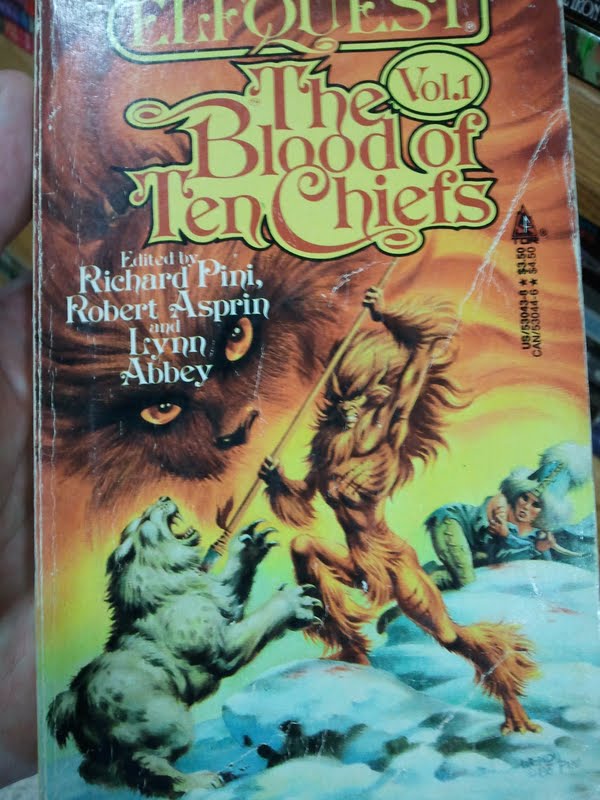
Book Covers

Every once in a while I head over to the web site Good Show Sir to see some of the worst book covers in science fiction and fantasy. It usually happens after I peruse the used book section at one of the only English bookstores in South Korea. As I look through the used book section, I see books that appear to have been there since the beginning of time.

Some Really Bad Covers:


Some Great Covers:


Over at SFFworld there is a thread of great book covers in which you are only allowed to post or discuss book covers that you like or find impressive. With all of the books published which are some of your favorite covers? Which covers do you find cringe-worthy? Does a book cover turn you off from a purchase or will you read a book simply based on the artwork?

Selasa, 10 Agustus 2010

REVIEW: Darkborn by Alison Sinclair

Darkborn by Alison Sinclair
Paperback: 352 pages
Publisher: ROC; 1 edition (11 Jun 2009)
ISBN-10: 045146270X
ISBN-13: 978-0451462701
Copy: Bought in bookshop
Reviewer: Cara

From the back of the book:
For the Darkborn, sunlight kills. For the Lightborn, darkness is fatal. Living under a centuries-old curse, the Darkborn and Lightborn share the city of Minhorne, coexisting in an uneasy equilibrium but never interacting.

When Balthasar Hearne, Darkborn physician, finds a pregnant fugitive on his doorstep just before sunrise, he has no choice but to take her in. Tercelle Amberley's betrothed is a powerful Darkborn nobleman, but her illicit lover came to her through the daytime. When she gives birth to twin boys, Balthasar realises that they can see - something unheard of among the Darkborn.

Two days after the birth, men arrive in search of the children. Balthasar is saved only by the intervention of his Lightborn neighbour - and healed by the hands of his wife, Telmaine. Soon Balthasar finds himself drawn deeper into a web of political intrigue and magical attacks as an ancient enemy of both Darkborn and Lightborn appears in a new guise, while Telmaine must confront a power she can no longer keep sheathed in gloves - a power she neither wants nor can control.


Darkborn is the first in a trilogy and also the first fantasy novel by Alison Sinclair who has previously written four science fiction books. The background is that the people in this world were cursed by a mage, Imogene, some 800 years before and divided into two distinct and separate societies, Darkborn and Lightborn. The Darkborn cannot go into sunlight and are blind; instead of sight they have another sense called 'sonn' which is similar to the kind of sonar used by bats. They revile all magic and possessors or magical abilities tend to live on the fringes of their society. The Lightborn, on the other hand, live in the sunlight and embrace magic. There is little interaction between the two societies and while they both live in the city of Minhorne it seems to be an uneasy co-existence.

Balthasar, a doctor, is catapulted into a world of conspiracy and intrigue after he finds the heavily pregnant Tercelle Amberley on his doorstep. She gives birth to twin boys who were fathered by a mysterious Lightborn figure. Afterwards, she returns to her life and powerful fiancĂ©e, leaving the twins to be hidden away by Balthasar’s sister. While this is happening, Balthasar’s wife, Telmaine, is spending time at court with her aristocratic family. She is hiding a secret, that she is the possessor of powerful magic which would cause her to be ostracised by society should this become known. Here she meets the enigmatic Ishmael di Studier, Baron Strumheller who has come from the border region where he watches for any incursion by the enemy, the Shadowborn, another, malevolent, product of the mage Imogene’s curse.

The first third of the book is taken up with descriptions of the main protagonists, who all share in the narration of Darkborn. The complex society, with it’s hierarchical structure and defined social roles is beautifully described. Although blind, the Darkborn have sonn to guide them, however, I found this ability took me some time to get used to. Once I had adjusted though, it became a fascinating way of perceiving the world. The events surrounding the birth of the twins, which lead to Balthasar being seriously assaulted and the kidnap of his daughter by two unknown men set the scene for Ishmael's involvement with the Hearne family. He helps Telmaine heal her husband using her magical abilities and investigates the kidnap of their daughter.

I found the middle third of Darkborn dragged somewhat. At one stage it seemed that a love triangle was being set up between the three main characters, which jarred with me. Ishmael and Telmaine had a strong connection from their first meeting, yet it was clear that she had a deep love for her husband, having gone against her family’s wishes to marry him. However, it became clear that it was their magical abilities that that drew them close rather than any romantic feelings. Balthasar, however, has a close, yet undefined relationship with his Lightborn neighbour, an intriguing woman, Floria White Hand, an assassin of the Lightborn royal court. She appears on the periphery of the central plot, however, as the next book in the trilogy is Lightborn, I think we will see more of Floria in the future.

Darkborn can be read as a standalone novel as the main strands of the plot are neatly tied up in the final third. There is an additional arc, however, that concerning the Shadowborn, enemies of both Dark and Light. This look set to continue in Lightborn and beyond to the concluding book in the trilogy, which is enough to make me interested in following the series through to the end. I enjoyed the style of writing, being descriptive without excessive detail. It was interesting to explore a society where sight is replaced by a sonar-type sense and so a lot of detail which I would normally expect – physical appearance, colours etc. are not relevant. I found Darkborn to be imaginative and clever, yet marred by a plodding middle third. This flaw, however, has not put me off wanting to read more.

Plot: 7
Characters: 7
Style: 6

Overall 7

Senin, 09 Agustus 2010

REVIEW: Soldier of the Legion by Marshall S. Thomas

Soldier of the Legion by Marshall S. Thomas
Publishing Information: Paperback; 298 pages
Publisher: Timberwolf Press 2007
ISBN 10: 1601453426
ISBN 13: 978-601453426
Series Book 1 of the Beta 3 series
Copy: Out of pocket
Reviewer: Tyson

Back of Book: "A rough truce divides the known galaxy between the System, the despotic slave empire that rules the inner systems, and the Confederation of Free Worlds. A ConFree unit is dispatched to defend a remote world from a mysterious Systie incursion. Our hero, call-sign "Thinker," will soon discover that giant exosegs, slavers and Systies are just the beginning. Once before the Legion faced the godlike, utterly alien and evil, Omnis, and drove them back at the cost of billions of lives. The future of humanity, all humanity - even the corrupt and decaying System empire, will soon be in the hands of Soldiers of the Legion."


As I was looking on the internet for a book similar to Heinlein's Starship Troopers and Scalzi's Old Man's War I found Marshall S. Thomas' Soldier of the Legion. The book does take a rookie soldier and talk of the exploits through the galaxy. However, that is where the similarities end.


The Heart of Soldier of the Legion is a loose attempt to capture the success of Heinlein and Scalzi and it starts out well. We learn the unit and their various shortcomings and at first I really enjoyed what I was reading but as the book dragged on the chacters began to lose their charm. I think part of it had to do with the characters of Priestess and Valkyrie. They are both hardcore female warriors and they both have staked a claim on our protagonist, "Thinker." Since they are the best looking women and natural born killers it made it hard to continue my suspension of disbelief. 


The plot is that there are two forms of government/philosophy in the universe one that believes in freedom and one that uses slaves for labor and any other tasks. If earth gave up slavery in the 1800s (for the most part), it did not make much sense that we returned to the practice once we took to the stars. I realise that the bad guys in Soldier of the Legion had to be despicable, but I would have like to have seen something different to set the two civilisations apart. Slavery to me was an easy out. 


Another thing that bothered me was that the book leaves you hanging. The end of the book is a cliffhanger. While I do not mind cliffhangers, the last 30 to 40 pages takes the reader on a completely different course from the rest of the book and then leaves you with the legion preparing to face death. The ending of Soldier of the Legion seemed rushed and I have to wonder if the Thomas was not sure what to do next so he just stopped and ran to the publishers and said "we will take care of it in book two." It left a sour taste in my mouth considering the short length of the book, Thomas could have at least ended the small skirmish and then give us a glimpse of the big picture and the first portion of the plot for the second book in the series but, he failed to do that.


Plot  6
Characters  7
Style  4


Overall 5/10